
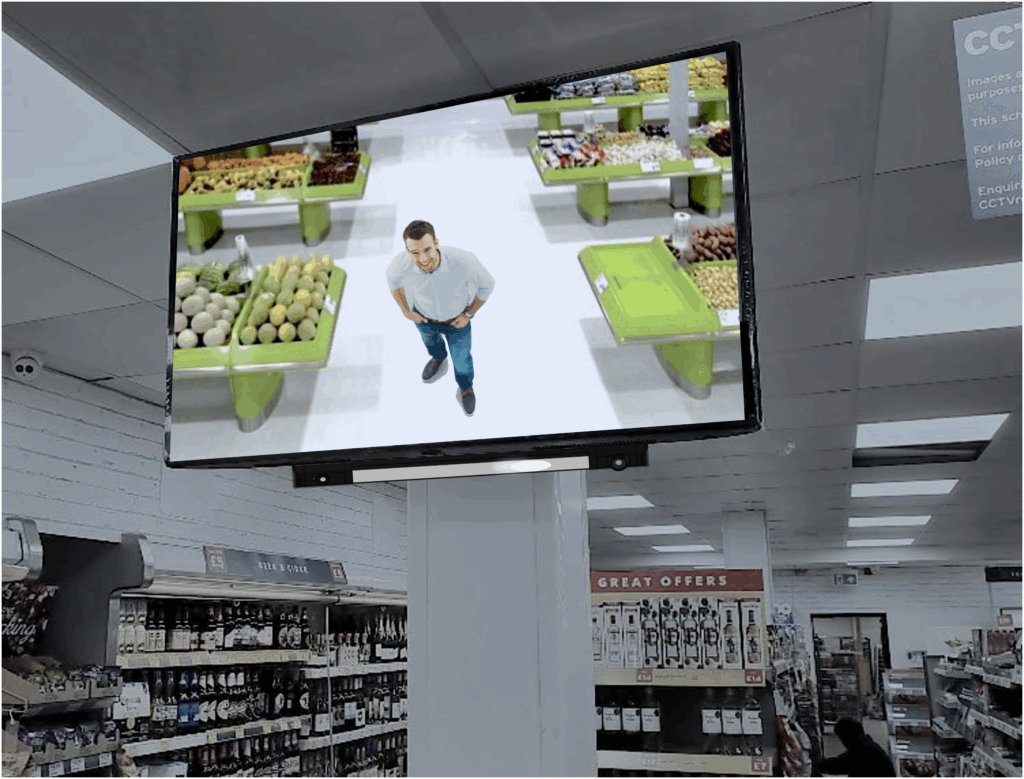

Security within retail environments has traditionally focused on physical controls — tagging, barriers, and post-event surveillance. While these measures remain necessary, they are inherently reactive. Increasingly, attention has shifted toward influencing behaviour at the point of decision, rather than responding after an incident has occurred.
Retail theft, particularly opportunistic shoplifting, is shaped less by capability and more by perceived risk and visibility. Where environments allow anonymity, concealment, or ambiguity around observation, the likelihood of offending increases. Conversely, where visibility is immediate and unambiguous, behaviour changes.
This is reflected in industry reporting and crime data, including trends identified by the Office for National Statistics, which highlight the persistent challenge of theft in retail environments.
Visibility and Decision-Making
At the point of potential theft, individuals are not assessing systems in detail. Instead, they are responding to immediate environmental cues:
- Can I be seen?
- Am I being monitored?
- How exposed am I if I act?
These cues align directly with Routine Activity Theory, which describes crime as occurring when three elements converge:
- A motivated individual
- A suitable opportunity
- The absence of a capable guardian
In retail environments, visibility functions as a substitute for guardianship. Increasing visibility increases perceived risk, and increased perceived risk reduces the likelihood of opportunistic behaviour.
Self-Awareness and Behavioural Adjustment
One of the most effective deterrent mechanisms in retail is the induction of self-awareness at the point of entry or decision.
When individuals become aware of their own visibility — particularly when encountering their own image on a Public View Monitor — behaviour changes. This is consistent with Self-awareness theory, where individuals regulate behaviour when they recognise themselves as observable.
In practical terms:
- The individual sees themselves
- Awareness of visibility increases
- Perceived anonymity is reduced
- Behaviour aligns more closely with expected norms
This effect does not depend on active monitoring. The perception of being seen is sufficient.
The Limitation of Passive Public View Monitors
Public View Monitors are widely deployed, but their effectiveness is often inconsistent.
A common issue is not capability, but attention:
- The monitor is present
- The camera is functioning
- But the individual does not look
Without engagement, the behavioural mechanism is never triggered. The system exists, but its deterrent value is not realised.
From Visibility to Attention
This introduces a more specific requirement within retail security design:
Visibility must not only exist — it must be noticed.
The challenge is not simply to display surveillance, but to ensure that individuals become aware of it at the critical moment.
Without this moment of awareness:
- Self-recognition does not occur
- Perceived surveillance is not activated
- Behaviour remains unchanged
The Pulsar Approach
Pulsar has been developed to address this precise gap — not by adding surveillance, but by activating attention toward existing surveillance systems.
It operates through a controlled lighting effect designed to:
- Draw the eye toward a Public View Monitor
- Create a moment of interruption or curiosity
- Prompt the individual to look and engage
Once attention is established, the existing system — the Public View Monitor — delivers the behavioural trigger through self-recognition.
Behavioural Mechanism in Practice
The sequence is deliberate:
- The individual enters or approaches a key area
- A visual lighting effect captures attention
- The individual looks toward the source
- They see themselves on the monitor
- Self-awareness is triggered
- Behaviour adjusts
This chain converts a passive system into an active behavioural deterrent.
Reinforcing the Capable Guardian
Within the framework of Routine Activity Theory, Pulsar contributes by strengthening the perception of a capable guardian.
It does not introduce new surveillance capability. Instead, it ensures that existing surveillance:
- Is seen
- Is understood
- Is behaviourally relevant
This increases perceived risk without increasing system complexity.
Application to Retail Shrinkage
Retail shrinkage is often driven by opportunistic behaviour occurring in moments of low perceived risk.
Addressing this requires:
- Reducing anonymity
- Increasing awareness of observation
- Interrupting automatic or habitual behaviour
By ensuring that individuals engage with visible surveillance at key points — entrances, high-risk zones, transitional areas — Pulsar supports a shift from passive monitoring to active deterrence.
Summary
Effective retail security depends on influencing behaviour at the point of decision. Visibility, self-awareness, and perceived surveillance all contribute to this outcome.
However, these mechanisms rely on one critical factor:
The individual must first become aware that they are being seen.
Pulsar operates at this point — not as a surveillance system, but as an attention mechanism that activates the deterrent value of existing infrastructure.
In doing so, it reinforces a simple but often overlooked principle: