

Escalating Deterrence Principles
Security lighting is often treated as a binary function — either on or off — yet this oversimplifies how deterrence actually works in practice. Increasingly, both crime data and environmental criminology point toward a more nuanced understanding: deterrence is driven by perception, visibility, and uncertainty, not simply illumination.
Across the UK, there is growing evidence that offenders favour lower-risk, lower-visibility targets, particularly sheds, garages and outbuildings. Analysis of “theft from outside the dwelling” by sources such as the Office for National Statistics shows this category remains significant, reflecting a shift toward opportunistic access points rather than forced entry into well-defended homes. Supporting this, insurer data from Aviva indicates that a substantial proportion of households have experienced theft or attempted theft from outbuildings, reinforcing their status as a primary vulnerability rather than a secondary concern.
The Metropolitan Police consistently highlight that sheds and garages are frequently targeted due to weaker physical security and reduced visibility, often containing tools that can facilitate further intrusion. In practical terms, these spaces sit outside the immediate “defensible space” of the home.
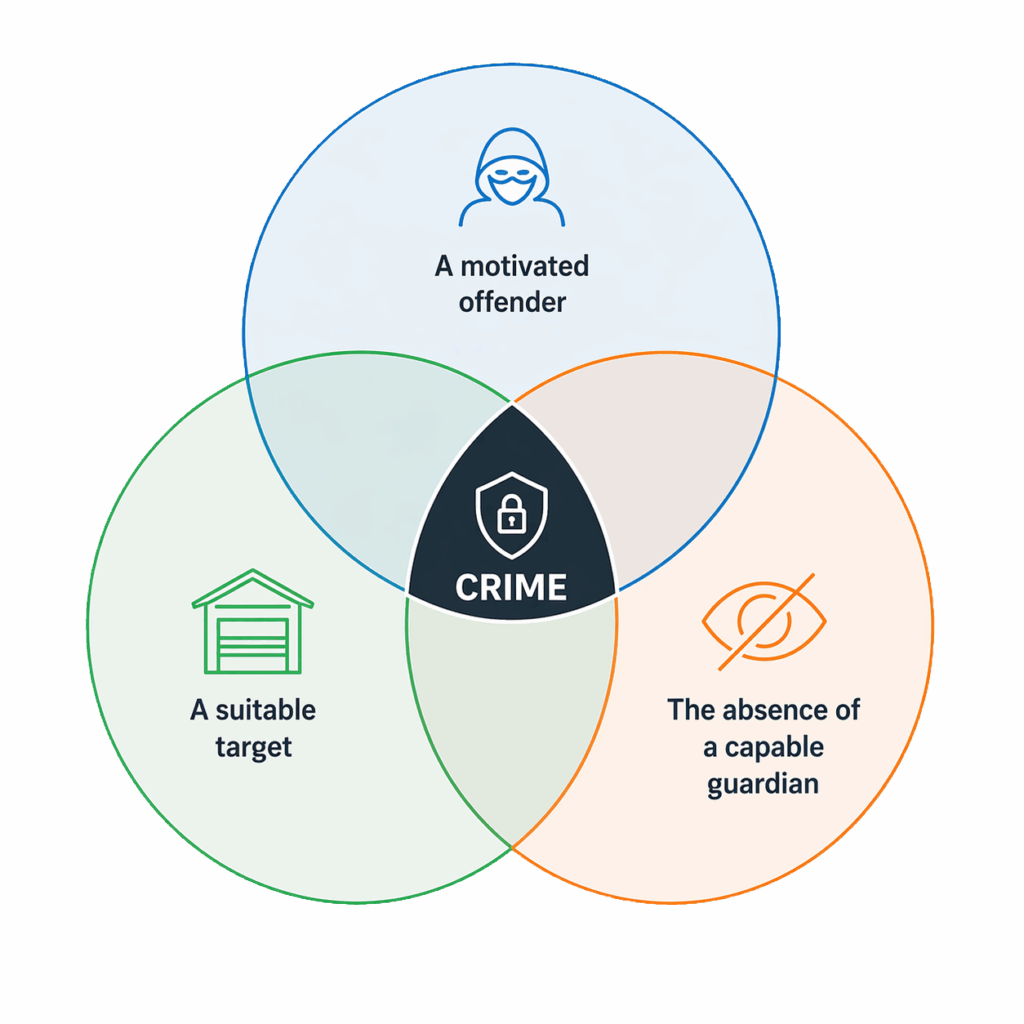
- A motivated offender
- A suitable target
- The absence of a capable guardian
Visibility as a deterrence mechanism
- Remove concealment around access points
- Increase the perceived likelihood of observation
- Signal occupancy or system awareness
It is this behavioural response — rather than the physical presence of light — that underpins its value as a burglary deterrent.
From Static lllumination to Escalating Response
Traditional motion-activated lighting provides a single-stage response: activation followed by a fixed level of illumination. While effective initially, this approach can become predictable, reducing its long-term deterrent value.
An alternative approach is to consider escalation — not in complexity, but in perception.
NightSabre operates across two clear modes:
- Motion-activated white light during hours of darkness
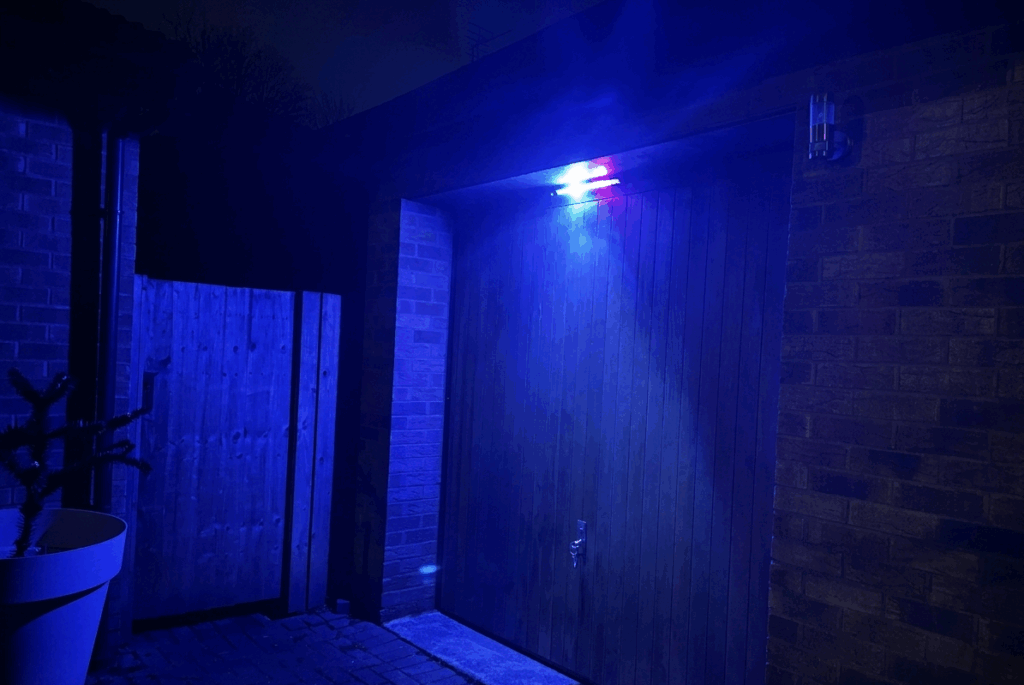
- Blue/red strobe response on alarm input
This simplicity is deliberate. It provides a clear, unambiguous shift from passive illumination to active signalling, without introducing unnecessary operational layers.
The Value of Escalation
The transition between these two states introduces three important deterrent effects:
1. Disruption of Expectation
A standard motion light is anticipated. A secondary, more assertive response is not. This breaks the intruder’s mental model of the environment.
2. Increased Perceived Risk
The introduction of blue/red strobing is widely associated with intervention or enforcement presence. Whether or not that presence exists is secondary — the perception alone increases the perceived likelihood of detection.
3. Loss of Anonymity
Escalation increases visibility at precisely the moment an offender is most exposed, removing the conditions under which opportunistic crime typically occurs.
Application to Outbuildings and Peripheral Areas
Outbuildings remain one of the least protected areas of a property, despite often containing high-value and easily resold items. Their separation from the main dwelling, combined with limited passive surveillance, makes them particularly susceptible.
As noted in UK crime reporting and insurance data, these areas are frequently targeted because they offer:
- Lower levels of lighting
- Reduced oversight
- Easier access and exit routes
In Routine Activity terms, they represent a convergence of target suitability and absence of guardianship.
Positioning Lighting Within the Security Hierarchy
Security measures are often layered — locks, alarms, cameras — but lighting occupies a distinct role within this hierarchy.
Unlike reactive systems, lighting operates at the pre-event stage, influencing decision-making before an offence occurs. It does not rely on monitoring or intervention; instead, it alters the conditions in which the decision to offend is made.
For this reason, motion-activated security lighting consistently appears among the most effective and accessible burglary deterrents in UK guidance and advisory content.
Summary
Escalating deterrence is not about complexity, but about clarity of response and strength of signal.
NightSabre’s dual-mode operation reflects this:
- A predictable, functional lighting response to movement
- A distinct, highly visible escalation when a threat is confirmed
Together, these reinforce a simple principle:
Deterrence is strongest where visibility is immediate, and escalation is unmistakable.